
Knox County Court Records After Arrest
After a Knox County arrest, two record tracks can exist at the same time. The first is the jail or booking record, usually tied to the arresting agency and the receiving jail. The second is the court record, which starts when a complaint, information, indictment, summons, warrant return, or other filing is entered by the court. For Knox County, the local court contact is the Knox County Circuit Clerk at the courthouse in Edina, while the prosecutor is the Knox County Prosecuting Attorney. Those offices handle different parts of the same event.
The Clark County Jail channel may show a booking charge for a person arrested in Knox County and held through the regional jail path. That charge is not the final word. A prosecutor can file a different offense, add a count, reduce a count, dismiss a count, or decline to file after review. Use jail inmate records for custody and booking details, and use jail roster mugshots for booking-photo questions. Use the court case record for the filed charge, hearing dates, bond orders, warrant entries, disposition, and financial obligations.
The Missouri arrest-record statute is a useful source for the public-record boundary. The Missouri arrest and incident records law makes many arrest records public, but it also allows closures and limits. Court access is a separate path through Case.net, the clerk, and the public docket when the case is open.
Find Knox County Court Records
Missouri court records are searched through Missouri Case.net. The portal is the official statewide court case search for public cases, though access can block automated tools and some records are not public. For a Knox County court record after a jail arrest, start with the defendant's name if the case number is not known. If the result list is broad, narrow the search by court location, case type, filing year, or the 2nd Judicial Circuit when those filters are available.
- Confirm the arrest first through the Knox County Sheriff's Office or Clark County Jail if custody is still unclear.
- Allow time for prosecutor review, since a very recent booking may not have a filed court case yet.
- Search Case.net by defendant name, then narrow to Knox County or the 2nd Judicial Circuit when the portal offers that filter.
- Open the matching case and read the filed charge, count number, docket entries, bond order, next hearing, and disposition fields.
- Call the Knox County Circuit Clerk if the case is older, missing, sealed, confidential, or difficult to match by name.
The image below comes from the Missouri Revisor page for RSMo 610.100, the arrest and incident records statute often used when a person asks for arrest material tied to a jail booking.
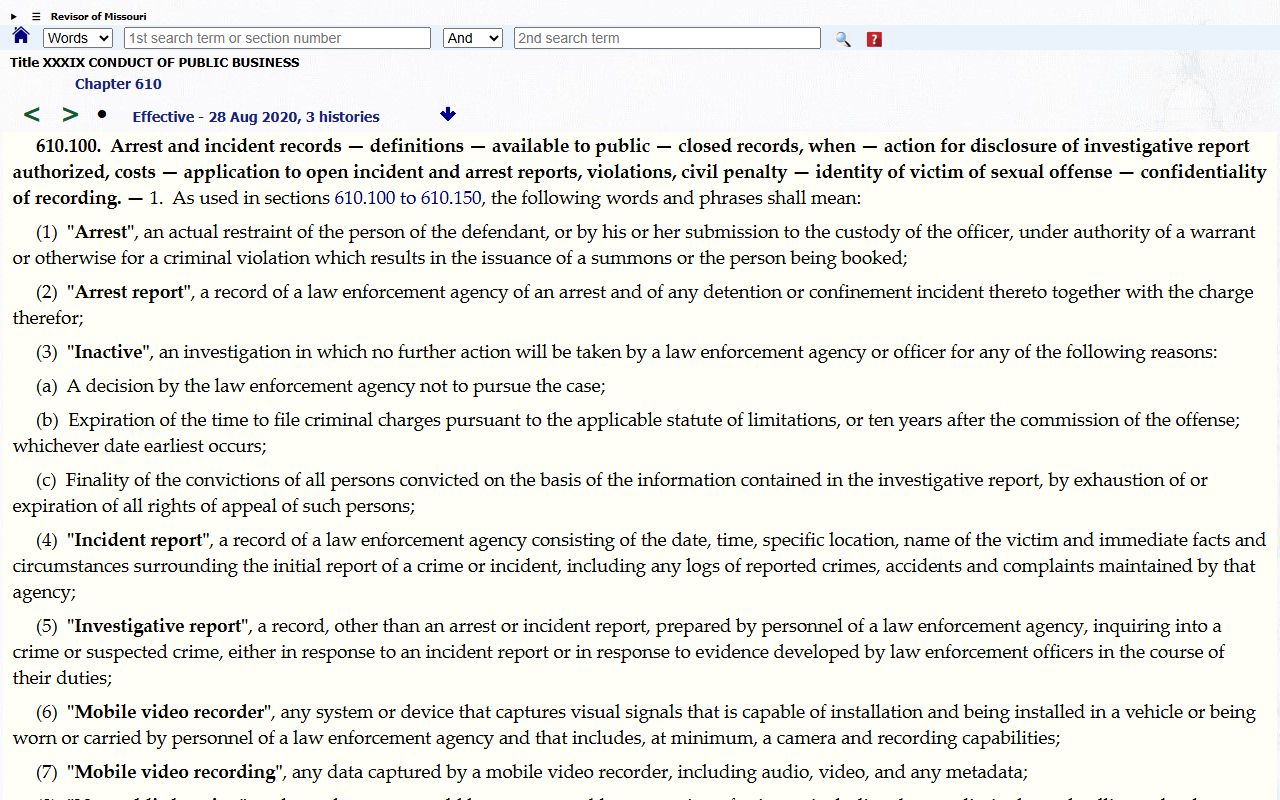
That statute helps explain why a booking record may be available while some investigative material, juvenile information, sealed cases, or safety-sensitive details remain closed.
Knox County Case.net Fields
Case.net is most useful when the user knows whether the search is name-based or case-number based. A case number is the cleanest path, but many people only have a booking date or a name from a jail roster. In that case, the search needs careful matching. Name spelling, middle initials, common surnames, and filing dates all matter because the court record is not the same document as the booking sheet.
| Field Label | Type | Required | Use in a Knox County arrest case |
|---|---|---|---|
| Search for Cases by Case Number | Text search mode | Case number required | Use when the number appears on bond papers, a summons, docket notice, or clerk paperwork. |
| Litigant Name Search | Text search mode | Last or business name required | Use the defendant's last name first, then add first or middle name to narrow matches. |
| Court Location | Dropdown | Optional | Choose Knox County or the 2nd Judicial Circuit when available. |
| Case Type | Dropdown | Optional | Criminal, traffic, municipal, civil, and probate choices can vary by court. |
| Filing Year or Date | Date or year filter | Optional | Use the arrest year or the week after booking to trim broad result lists. |
| Track This Case | Action | Optional | After the case is found, use alerts for later docket activity when the portal offers tracking. |
Knox County Charging Documents
A court record after a jail arrest usually begins with a charging document. The jail roster may use short charge text supplied during booking, but the court file uses documents filed through the prosecutor or court. In Missouri practice, the key terms are complaint, information, and indictment. Each one is a formal way to state the accusation in court, and each can be amended under court rules and orders.
| Document | Who uses it | What it does | What to compare |
|---|---|---|---|
| Complaint | Officer or prosecutor | Starts or supports a criminal case, often with probable-cause facts. | Compare the alleged offense with the booking charge and warrant entry. |
| Information | Prosecutor | States formal prosecutor-filed charges for many Missouri criminal cases. | Use this as the filed charge when it differs from the jail roster. |
| Indictment | Grand jury | Charges an offense through grand-jury action in cases where that route is used. | Read count numbers and offense levels carefully because wording may differ from booking text. |
Knox County's current prosecutor listing names Chelsea Fallinger, Interim Prosecutor, at 107 N 4th St. Ste B, Edina, MO 63537. The office phone is 660-397-2658, fax is 660-397-2666, and the county offices page lists chelsea.fellinger@prosecutors.mo.gov as the email. Use the county offices listing as the current source when checking the prosecutor contact.
Knox County Charge Status
Charge status explains where a count stands at a point in time. It is not the same as a conviction. A person may be arrested, booked, charged, and later have the charge changed or dismissed. A charge can also be resolved by plea, trial, diversion, probation terms, or another court order. The docket should be read by count, not just by the first charge line shown in a search result.
| Status | Plain meaning | Why it matters after arrest |
|---|---|---|
| Pending | The count is still open. | Future hearings, bond terms, and discovery may still be active. |
| Amended | The filed count was changed. | The court charge may no longer match the original booking charge. |
| Reduced | The offense level or charge was lowered. | Read the latest docket entry before describing the case outcome. |
| Dismissed | The count was dropped by court action. | A dismissed charge is not a conviction, though the arrest record may still exist unless closed or expunged. |
| Disposed | The court has entered an outcome. | The record may show plea, trial result, sentence, costs, or other final orders. |
Bond and Knox County Warrants
Bond information can appear in both the jail and court tracks, but the court order controls release conditions once a case is filed. A cash bond means money is posted with the court or jail under the terms set by the court. A surety bond involves a bail agent or surety. A recognizance release, often called PR or own recognizance, is a promise to appear with conditions. A no-bond hold means ordinary release is not available at that stage.
No official active Knox County warrant search was found on the county or sheriff sites. For warrant questions, use the Knox County Sheriff's Office, the Knox County Circuit Clerk, Case.net docket entries, or an attorney. If custody is suspected, call Clark County Jail as well. A bench warrant for missing court, an arrest warrant, a probation or parole hold, a fugitive warrant, or another agency detainer can keep a person in custody even when a local bond amount appears on a roster.
For clerk help, contact Knox Circuit Clerk Kimberly Hatfield at 107 N 4th St, Edina, MO 63537. The office phone is 660-397-2305, fax is 660-397-3331, and the listed email is kimberly.hatfield@courts.mo.gov.
Charges vs Convictions
A Knox County court record after a jail arrest can show accusations long before it shows an outcome. That distinction is important for reading public records fairly. A booking charge and a filed charge show what was alleged at a point in the process. A conviction requires a plea, verdict, or other final finding entered by the court.
| Point of comparison | Charge | Conviction |
|---|---|---|
| Stage | An accusation listed in a booking record or court filing. | A final court outcome after plea, trial, or other adjudication. |
| Proof level | May start from probable cause or prosecutor review. | Requires the legal standard tied to conviction in criminal court. |
| Can change | Yes. It can be amended, reduced, or dismissed. | It can be appealed, set aside, expunged, or otherwise affected only through lawful court action. |
| Where to verify | Case.net docket and the Knox Circuit Clerk. | Final docket entry, judgment, sentence, and clerk record. |
Sealed and Expunged Records
Public court access does not mean every record is visible forever. Juvenile cases, confidential matters, sealed records, closed investigative material, victim-identifying information, and expunged criminal records can be withheld or redacted. The Missouri expungement statute is the main statewide source for eligible criminal-record expungement and closure from general public access.
| Point of comparison | Sealed | Expunged |
|---|---|---|
| Public visibility | Closed or hidden from general public view by rule or order. | Closed from general public access after an eligible court order. |
| How it happens | May result from case type, confidentiality law, or court order. | Requires a statutory expungement process and court order. |
| Effect on searches | Case.net may show limited detail or no public result. | Public search tools may no longer show the record. |
| Where to ask | Knox Circuit Clerk or legal counsel. | Knox Circuit Clerk or legal counsel after reviewing eligibility. |
Restricted Knox County Court Records
Some missing results are not errors. A recent arrest may still be waiting on prosecutor filing. An older matter may require clerk help. A sealed, juvenile, expunged, or confidential case may not appear to the public. Open government law favors access to public records, as stated in RSMo 610.011, but that policy works with specific closure laws and court orders.
Important: Public search results are not consumer reports and should not be used for credit, employment, housing, insurance, or other FCRA-covered decisions.